
Status: 1.1 · out now
FRASIL


Drone textures frozen in motion
A custom firmware that turns the M-VAVE FM-1 into an instrument for ambient drones and textures.
The instrument1/11
The notes stay where you put them. The sound is never still.
FRASIL turns the M-VAVE FM-1 into an instrument for ambient drones and textures. A tap latches a drone: a note, or a chord built in the key you chose. Pressing harder makes it swell. The timbre drifts and ebbs on its own, slowly, and everything flows into a large, lush reverb with shimmer and freeze.
Your notes, and chance where you let it
The drones are the notes you light, and they never change. Above them, GLINT plays small icy bells; under them, BASS holds one deep note, or walks a slow line of its own. GLINT’s arpeggiator plays the keys you hold; GLINT’s sequencer and the bass’s play the steps you write. Chance comes in only where you let it: CHANCE skips steps, RANDOM and DRIFT pick the arpeggio’s order, SPARKLE lets glints fall on the notes your drones hold.
Who it is for
For players who want a sound to hold rather than a pattern to follow. FRASIL is designed as one voice in a larger setup: it takes MIDI notes, pressure, CCs and clock over USB and TRS, a channel for each of its tracks.
- 8drone voices
- 3layers each
- 60 sof reverb tail
- 22GLINT presets
- 8bass models
- 16scenes
Pressure2/11
Pressure warms the ice.
On the screen, every voice is a current carrying ice. Hold a key and press into it: the voice swells and opens, and its crystals warm to lamp light. Let go, and it stays lit.
- Tap a key
- It rises over ATTACK and stays.
- Tap it again
- It fades over RELEASE.
- Hold and press
- It swells and opens. PRESSURE sets how much.
- Hold ENV
- SWELL: after 0.4 s, every voice swells together.
- SWELL, on FX
- Every voice swelled as far as you turn it, and held there.
Layers3/11
The current, the crystals, the mist.
Every note you light is a voice, up to eight, and every voice has three layers. All three play every note: you mix them and shape each one. On the screen each is a thing in the river, and strata under the waterline show the exact mix, WARMTH with it.
-

CHOIR the current
Three detuned saws, or pulses, through a low-pass filter that follows the note. Warm, wide, vocal.
CHOIR II SHAPE takes the saws toward a square, hollow and woody, then narrow pulses, bright and nasal. INTERVAL moves the centre saw an octave or a fifth; RESONANCE and TYPE shape the filter: LOW, BAND or HIGH.
-

PARTIALS the crystals
Eight additive harmonics, each drifting on its own in level and tuning. Bright or dark, odd, stretched into bells, with a formant.
PARTIALS II EVOLVE lets their levels wander deeper and quicker; BEAT makes each one pulse at its own pace. FORMANT and PEAK lift them around one harmonic, as a vowel does, up to that one alone: the drone sings a single overtone.
-

BREATH the mist
Noise, a hiss or sparse grains, through three resonators tuned to the note, from air to glass.
BREATH II GRAIN turns the hiss into grains that ring like ice ticking, or rain on glass. PITCH moves the resonators an octave down, or up into a halo over the drone.
24 drones PRESETS, on any page: each sets the three layers and the drone’s own
- MIST
- CATHEDRAL
- GLACIER
- ABYSS
- AURORA
- EMBER
- TIDE
- DUST
- WIND
- ORGAN
- HOLLOW
- VOWEL
- SHIMMER
- CHANTER
- ENSEMBLE
- BELLS
- NOCTURNE
- HAZE
- PULSE
- RIME
- DEEP
- SPECTRAL
- RUST
- STILL
And CUSTOM your own: turn any of their settings and the drone becomes CUSTOM
Your drones’ notes never change. What moves on its own is the sound: MOTION, a slow random drift of each partial, detune and resonance; TIDE, a slow swell of the timbre over minutes. Turned up, CHANCE and SPARKLE let chance into GLINT’s notes.
LFO 1 · LFO 2 · LFO 3
Press LFO again: three LFOs of your own, seven shapes, free or on the beat. Each moves up to four settings together, around the values you gave them; a scene keeps it all.
LFO 1 · SHAPE
Cloud4/11
Everything flows into the cloud.
WARMTH, a soft saturation, feeds CLOUD, the reverb: eight modulated lines with diffusion inside their loop, a pre-delay, and a shimmer pitched inside the loop. Its tail runs from 0.4 to 60 seconds.
Generative FX
FX opens on four knobs that play the whole sound. SWELL swells every voice and holds it there; SPARKLE lets glints fall by themselves, now and then, on the notes the drones hold; BLUR dissolves the drone into the cloud; SINK takes everything under, a low-pass on the whole mix.
Freeze
Hold FX: the cloud holds what is in it, without end and without darkening. Nothing more goes in: what you play next sounds dry over it. Hold FX again and it thaws, fading over DECAY. On the screen, the crystals set into a lattice and the water stills.
- CLOUD
- SIZE
- DECAY 0.4–60 s
- TONE
- FREEZE OFF · ON
- CLOUD II
- DIFFUSION
- MODULATION
- PRE-DELAY 0–200 ms
- WIDTH
- CLOUD III
- SHIMMER
- INTERVAL +12 +7 +5 +19 −12
- BRIGHT 700 Hz–8 kHz
Glint5/11
Small icy bells, above the drones.
GLINT is four voices of clean two-operator FM, played from the keys once SELECT turns them over to it. Never latched: each note rings and fades like a bell, while the drones keep sounding under it.
SEQ
MODE
The hand
Pressure makes a glint louder and longer. With VIBRATO, a wiggle of the finger bends its pitch, both ways around the note, as a string player’s does; a steady press stays in tune. SUSTAIN turns a bell into a lead.
The arpeggiator
It plays the GLINT keys you hold, one at a time, at RATE, over RANGE octaves, on the grid of MIDI clock or TEMPO. LATCH is on from the start: the pattern keeps playing after you lift your hands. Hold ARP to turn it off, or on again. Tap PLAY and it waits; again, it goes on from the top.
The sequencer
SEQ on SEQ (GLINT I, K2): 32 steps in place of the arpeggio, on the same grid. REC goes straight there and records you live as it runs, to a metronome; or write it a key a step. With RECORD off, the keys transpose it along the scale. PLAY stops it; again, it starts from the top. A NEW TAKE starts it over from nothing, and UNDO brings back the one before.
The delay
GLINT’s own, tempo-synced, from 1/32 to 1/2 with triplets and dotted times, mono or ping-pong. Its echoes go into the cloud too.
22 presets
- ICE
- BELL
- BLIP
- GLASS
- CHIME
- DROP
- FROST
- CELESTA
- SINE
- KALIMBA
- MARIMBA
- MUSIC BOX
- VIBES
- HARP
- PIPE
- BOWED
And six leads SUSTAIN holds them while the key is down
- WARM LEAD
- BRASS
- SQUARE
- SUB LEAD
- STRINGS
- REED
Bass6/11
One deep note, held like a drone.
Turn SELECT to BASS and the keys play it: one note at a time, the key’s note in the scale, OCTAVE octaves down. Tap another key and it glides there without starting again; tap its own key and it lets go. Press into it: louder, and its filter opens.
Or let it walk. The bass has a step sequencer of its own, two more pages under SEQ: sixteen steps, each a NOTE, a CUT or a HOLD, and each as long as you want it, from a sixteenth to four bars. A slow line under drones that never change. Write it step by step or live with REC, move it with a key; PLAY starts it with GLINT’s, on the same grid, and each scene keeps its own.
DRIVE into a soft clip, a resonant low-pass, and none of it in the reverb. A pure sine this low barely reaches the FM-1’s small speaker: DRIVE, or a richer MODEL, gives it the harmonics that let you hear it there. In headphones, SINE with DRIVE at 0 is a clean sub.
- SINEpure
- TRIANGLEsoft, a little hollow
- SQUAREhollow, woody
- SAWbright, buzzing
- REESEtwo saws ten cents apart, beating slowly
- SUBthe sine and its octave below
- ORGANthree drawbars: the note, its octave, its twelfth
- FMa sine modulating itself: round, growling
Harmony7/11
Set a key once. Every key you tap belongs to it.
Twelve scales, eight chords built from the scale’s own notes and seven fixed ones, three voicings. A key outside the scale plays the scale’s note just below it, and the scale’s keys glow faintly.
D3 plays D3 · F3 · A3: in D MINOR with TRIAD, a chord of the scale’s own notes.
Mixer8/11
The river breathes on the beat.
HOME’s second screen is a MIXER: a fader and a live meter for DRONE, BASS, GLINT and CLOUD, the reverb’s return.
- PUMP
- Ducks each track on the beat, as a sidechain from a kick would, without a kick: from 4 BARS to 1/8, on MIDI clock or TEMPO. DRONE, BASS and GLINT set how deep each one goes; the cloud pumps with the drones.
- MASTERING
- A light compressor on the whole output, its gain reduction on the screen, live.
PUMP · RATE
Scenes · MIDI9/11
Sixteen scenes. A channel for each track.
A scene holds the sound, the latched drones, GLINT’s arpeggio and its sequence, and the bass with its own. Hold SAVE and press REC to store one; hold SAVE and press a white key to load one of the sixteen, from any page. MORPH glides into it, over up to two minutes, and LOAD on SND ONLY leaves what plays playing while only the sound changes. Eight slots hold the factory scenes; eight are free.
- 01MISTD, chromatic · SINE
- 02GLASSA lydian, ADD9 wide · GLASS
- 03ABYSSD phrygian, FIFTH wide · DROP
- 04CHORALED minor, SEVENTH open · BELL
- 05WINDE penta minor, mostly BREATH · FROST
- 06BELLSC major, QUARTAL open · CHIME
- 07TIDEF dorian, SUS2 open · BLIP
- 08AURORAG mixolydian, TRIAD wide · CELESTA
MIDI over USB and TRS
Each track has its own channel, whatever the keys play. The drones’ notes go through the harmony, so a sequencer’s single note plays a chord; GLINT’s and BASS’s play as they come. Polyphonic aftertouch swells a note; channel pressure, the whole track. Program Change loads the scenes. Hold GLO and move a knob on your controller: it now turns the setting you touched last. Clock drives GLINT’s arpeggiator, its sequencer and its delay, the bass’s sequencer, and the synced LFOs; Start resets the grid and starts the sequences.
- CH 1DRONE
- CH 2GLINT
- CH 3BASS
The screen10/11
A river at night, 240 pixels square.
Pitch is height above the waterline. Each voice is a current carrying ice; GLINT shines in the sky above; the bass is a slow swell across the river. Every setting wears the badge of the control that turns it: a blue disc for K1–K4, an orange one for the three encoders on the left.
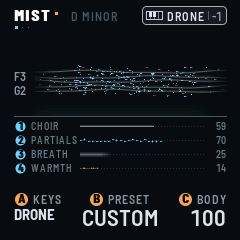
The play pageThree voices sounding, the drone's mix under the waterline. 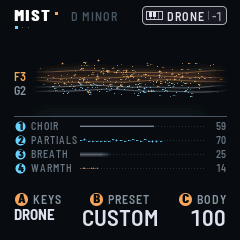
PressureA held key pressed in: its voice glows amber. 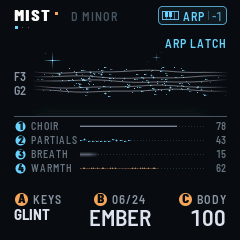
GLINTSELECT on GLINT, then a few keys: notes shining above the river. 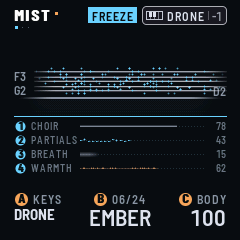
FREEZEFX held: the crystals set into a lattice. 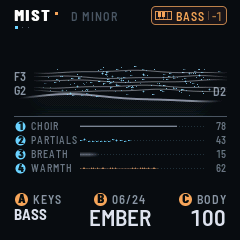
BASSSELECT on BASS, then a key: a slow swell across the river. 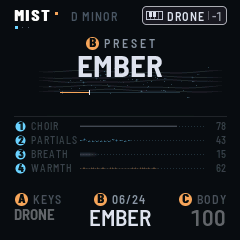
A left encoder turnedPRESETS: the drone's preset, large over the river. 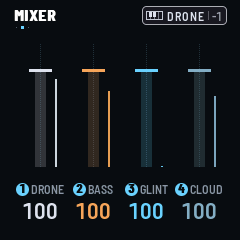
MIXERHOME on the play page: four faders and their meters. 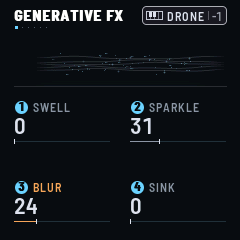
GENERATIVE FXFX: SWELL, SPARKLE, BLUR, SINK. 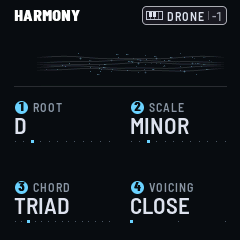
HARMONYSEL: D, MINOR, TRIAD, CLOSE. 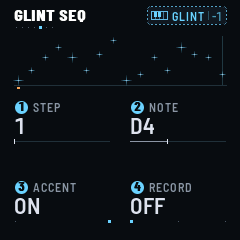
GLINT SEQREC, or ARP five times with TYPE on SEQ: sixteen steps, an accent on each beat. 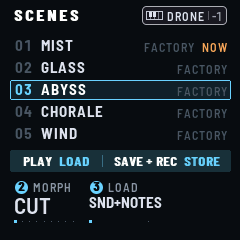
SCENESSAVE: slot 03, ABYSS; MORPH, LOAD. 
The logo screenHOME on the MIXER: the logo, alive.
Install11/11
1.1 · out now
Try it first. Then give it to the FM-1.
-
01
In the browser
The emulator runs the same code the FM-1 runs, with sound. No FM-1 needed.
Play -
02
On the FM-1
From the browser: Chrome or Edge, the FM-1 connected by USB, through FRASIL on The FM-1 Firmware Hub. From a terminal: download
frasil-X.Y.fwscfrom the releases, then, from a checkout of the repository:
Downloadpython3 base/tools/fm1_install.py frasil-X.Y.fwsc -
03
And back
Install M-VAVE’s V15 from the hub. If the FM-1 no longer starts, hold OCT− while you switch it on: it waits for an update over USB.
The install guide
Good to know Installing is at your own risk; the installer can always put M-VAVE's own firmware back.