Guide 02 / 16
How FRASIL works
The keys play one set of notes. Every note you light is a voice, up to eight, and every voice has three layers.
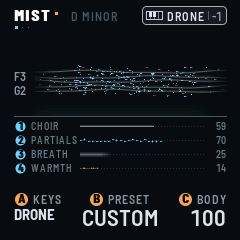
×7: the drone, each layer and its second page
Three layers, one voiceLink to this section
- CHOIR three detuned saws (or pulses) through a low-pass filter that follows the note. Warm, wide, vocal.
- PARTIALS 8 additive harmonics, each drifting on its own in level and tuning. Bright or dark, odd, stretched into bells, with a formant.
- BREATH noise (a hiss or sparse grains) through three resonators tuned to the note, from air to glass.
Each layer has two pages on EDIT: the first its level and main character, the second (CHOIR II, PARTIALS II, BREATH II) its source and what shapes it after. See the layers’ second pages.
You don’t choose a layer per note: all three play every note, and you mix and shape them.
The whole droneLink to this section
Before the layers, the first page on EDIT, DRONE PARAMS, shapes the whole drone: TIMBRE (all three layers brighter or darker), SPACE (how much of it goes to the reverb), MOTION (how far it drifts) and BODY. At 100 % BODY leaves the drone as its settings make it. Turned down, it thins it out without changing them: the choir closer and quieter, fewer partials, little breath, narrower, less warmth, its low body taken off. BODY is on ALGORITHM too, on every page, and an LFO can move it.
The drone’s presetsLink to this section
Turn PRESETS, on any page: 24 drones, each setting the three layers (their levels, both their pages) and the drone’s own: DRONE PARAMS but BODY, DRONE SHAPE’s ATTACK and RELEASE, DRONE MOTION. The cloud, PRESSURE, VELOCITY and BODY stay as they are.
Before them comes CUSTOM, your own. Turn any of those settings and the drone becomes CUSTOM, from where it was. Another preset doesn’t lose it: turn back to CUSTOM and it is there. A scene keeps its CUSTOM, and the preset chosen over it.
- 01MIST
- the default: all three layers, gently
- 02CATHEDRAL
- a wide choir an octave under, a long hall
- 03GLACIER
- glass: stretched partials, bell resonators
- 04ABYSS
- dark and deep, warm
- 05AURORA
- the spectrum wandering, a light formant
- 06EMBER
- a warm square choir, glowing low
- 07TIDE
- a deep tide on the timbre
- 08DUST
- grains ringing in resonators, crackle
- 09WIND
- air: breath alone, moving
- 10ORGAN
- steady pipes, a fifth over
- 11HOLLOW
- odd harmonics, a band-passed square
- 12VOWEL
- a sung overtone
- 13SHIMMER
- bright beating partials, a halo a twelfth up
- 14CHANTER
- a reed: a narrow pulse, nasal
- 15ENSEMBLE
- strings: detuned pulses, swaying
- 16BELLS
- stretched into bells
- 17NOCTURNE
- slow and dark, a resonant low-pass
- 18HAZE
- airy, high-passed, an octave up
- 19PULSE
- every partial beating, quick
- 20RIME
- thin ice two octaves up, glittering
- 21DEEP
- weight: the fundamental, an octave under
- 22SPECTRAL
- one overtone alone, singing
- 23RUST
- gritty, driven: grains, a resonant band
- 24STILL
- almost a sine, unmoving
Where the sound goesLink to this section
Then WARMTH (a soft saturation) feeds CLOUD, the reverb: an 8-line modulated network with diffusion in its loop, a pre-delay, a pitch-shifted shimmer inside the loop, and FREEZE. Its tail runs from 0.4 to 60 seconds.
The tracks
The reverb
The mix
The output
What moves on its ownLink to this section
Your drones’ notes never change. What moves on its own is the sound: MOTION is a slow random drift of each partial, detune and resonance; TIDE is a slow swell of the timbre over minutes. Chance comes into GLINT’s notes only where you let it: CHANCE skips the arpeggio’s or the sequence’s steps, RANDOM and DRIFT pick the arpeggio’s order, and SPARKLE (below) plays glints of its own on the notes the drones hold.
And what you set moving: three LFOs, each on up to four settings, free or on the beat. A setting keeps the value you gave it, and the LFO moves the sound around it. See The LFOs. On FX’s first page, SPARKLE lets glints fall by themselves, now and then, on the notes the drones hold (see Generative FX).
GLINT and BASSLink to this section
GLINT is a separate layer on top: 4 voices of clean FM, played from the keys when you turn them over to it (SELECT: KEYS; ARP’s pages do it too). GLINT notes are never latched: each one rings and fades like a bell. The drones keep sounding while you play GLINT, by hand, through its arpeggiator or from its 32-step sequencer. See GLINT.
BASS is a third thing the keys can play (SELECT on BASS, or SEQ’s pages): one deep note at a time, held like a drone, under everything, or a line of its own from its 16-step sequencer. It stays out of the reverb, but for a little SPACE. See BASS.