
Guide 08 / 16
GLINT
Small icy FM bells over the drones, and leads: by hand, or through an arpeggiator or a 32-step sequencer that follow MIDI clock.
Hold ARP: latch · REC: record
Playing GLINTLink to this section
Press ARP (come from another section, its pages put the keys on GLINT), or turn SELECT (KEYS) to GLINT: the keys play GLINT (the badge at the top right turns blue, and says what they do: GLINT, ARP, SEQ, or REC in orange). Back to DRONE for the drones, on to BASS for the bass. A key plays an icy FM bell in the scale, OCTAVE octaves up (two by default, from +0 to +3). Pressing it makes it louder (up to +8 dB) and makes it ring longer.
VIBRATO (GLINT II, K4): once your finger has pressed in, wiggling it bends the glint’s pitch, both ways around its note, like a string player’s finger. A steady press stays in tune. Up to 25 cents at 100; about 10 at its default; OFF at 0.
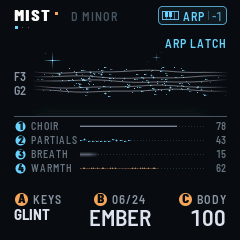
Its pagesLink to this section
Tap ARP, then ARP again for the next page: GLINT I, GLINT II, GLINT ADSR and GLINT DELAY, always the fourth. SEQ, on the first (K2), says what plays GLINT besides your hands: OFF, ARP (the arpeggiator) or SEQ (the sequencer). Its pages come after GLINT DELAY: GLINT ARP for the arpeggiator, the three GLINT SEQ pages for the sequencer, none with SEQ OFF (four pages).
If the page you are on goes away (SEQ changed, a scene loaded), you land on GLINT I.
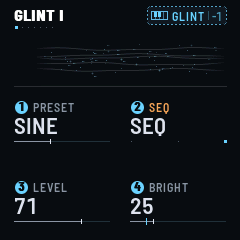
| Page | K1 | K2 | K3 | K4 |
|---|---|---|---|---|
| GLINT I | PRESET | SEQ OFF, ARP, SEQ | LEVEL | BRIGHT FM index |
| GLINT II | OCTAVE +0 to +3 | RATIO ×0.5 to ×13.6 | PING strike or ring | VIBRATO OFF, the wiggle’s depth |
| GLINT ADSR | ATTACK 2 ms to 1.5 s | DECAY 80 ms to 6 s | SUSTAIN 0 to 100 %, the level held | RELEASE 20 ms to 6 s |
| GLINT DELAY | TIME 1/32 to 1/2, triplet and dotted; then the same, ping-pong (PP) | FEEDBACK | MIX | SPACE GLINT’s reverb send |
| GLINT ARP SEQ ARP | MODE UP, DOWN, UPDOWN, RANDOM, DRIFT | RATE 1/1 to 1/32, triplets | RANGE 1 to 3 octaves | CHANCE |
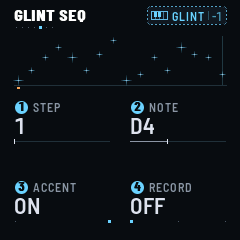
| GLINT SEQ SEQ SEQ | STEP 1 to 32 | NOTE REST, a note, TIE | ACCENT OFF, ON | RECORD OFF, STEP, LIVE |
| GLINT SEQ II | SEQ LENGTH 1 to 32 steps, 16 by default | RATE | GATE each note’s length, 5 to 100 % of its step | CHANCE |
| GLINT SEQ III | TRANSPOSE −14 to +14 steps of the scale | CLEAR turn twice | NEW TAKE turn twice | UNDO TAKE turn twice |
RATE and CHANCE are the same two settings on GLINT ARP and GLINT SEQ II: the arpeggiator and the sequencer share them. OCTAVE (GLINT II) applies live to both: their notes are kept without it and played with it.
PresetsLink to this section
ICE, BELL, BLIP, GLASS, CHIME, DROP, FROST, CELESTA, SINE (the default), KALIMBA, MARIMBA, MUSIC BOX, VIBES, HARP, PIPE, BOWED, and six leads: WARM LEAD, BRASS, SQUARE, SUB LEAD, STRINGS, REED. A preset sets the page’s sound, its RELEASE too. Turn RATIO, BRIGHT and the rest from there.
The envelopeLink to this section
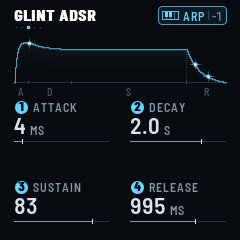
GLINT ADSR, ARP’s third page, is the envelope, in its usual order: ATTACK, how long a glint takes to rise; DECAY, how long it then takes to die away to silence, or, while its key is down, to SUSTAIN’s level; SUSTAIN, the level it holds while the key is down; RELEASE, how long it rings on once its key is let go (600 ms by default). Scenes and shards from before RELEASE come with one that matches what their DECAY did then (DECAY’s time up to 0.6 s, else half of it, 0.6 s at least): they sound as they did.
On GLINT ADSR the river strip draws the envelope: ATTACK up to the top, DECAY down to SUSTAIN’s level, SUSTAIN’s plateau, RELEASE down to nothing, each part as wide as its knob is turned (the plateau takes what is left), its time across it, A D S R under it. The part whose knob you turn is lit. Each glint sounding, up to four, is a little ice-blue glint riding the curve: it waits at the end of the plateau while its key is held, then goes down RELEASE once let go.
SUSTAIN: a bell becomes a leadLink to this section
SUSTAIN (GLINT ADSR, K3) turns a bell into a lead. At 0 a glint fades out over DECAY, even while you hold its key. Turned up, it settles at that level for as long as the key is down, then rings out over RELEASE when you let go. DECAY is then how long it takes to settle, and PING (GLINT II) the brightness at the start, as a filter’s sweep would be. The leads use it, with RATIO at ×1 (all the harmonics, as a saw has), ×2 (the odd ones, hollow, as a square) or ×0.5 (an octave under).
The arpeggiatorLink to this section
With SEQ on ARP, it plays the held GLINT keys one at a time, at RATE, over RANGE octaves, in MODE’s order. CHANCE decides whether each step plays. It follows MIDI clock when one comes in, and TEMPO (GLOBAL, K1) otherwise. It stays on the grid: a new chord, an added or a lifted note takes effect on the next RATE step, and the pattern starts again from its first note. MIDI Start resets the grid.
Latch: hold ARP. With LATCH on (the default), the arpeggio keeps playing after you lift your hands, even back on the drones. A new hand replaces the chord. Hold ARP again to turn it off. Turned on, LATCH puts SEQ (GLINT I, K2) on ARP too if it was OFF or on SEQ, as turning it there would (a sequence playing stops); turned off, it leaves SEQ as it is. Tap PLAY and the arpeggio waits, its notes kept; tap it again and it goes on from the top, the beat beginning there. Hold PLAY to let it go with everything else.
The key whose note is sounding lights up for as long as the note lasts.
The sequencerLink to this section
With SEQ on SEQ, a 32-step sequence plays GLINT in place of the arpeggio, on the same grid: RATE, MIDI clock or TEMPO, and CHANCE for each step. RANGE has no say in it. It plays on without end while the sequencer is on. PLAY stops it, and PLAY again starts it from its first step, at once, the beat beginning there; MIDI Start starts it from the top too.
REC goes straight there, recording LIVE: the sequencer on, the keys on GLINT, RECORD on LIVE, GLINT SEQ on screen, and the sequence started if it was stopped. REC again, on LIVE or STEP, turns RECORD off; the page stays. REC keeps the sequence as it was before the take, for UNDO TAKE.
While RECORD is on, STEP or LIVE, however you turned it on (REC, K4, NEW TAKE), the keys play GLINT; RECORD off gives them back to what they played before (RECORD OFF · DRONE).
On LIVE, a metronome counts the sequence’s own beats from its first step: a tick each beat, the higher one as the sequence comes round to its first step. A sequence that is not a whole number of beats long starts its beats again from its first step each time round. REC flashes on the same beats, twice as quick as OCT. On STEP the metronome is silent and REC stays lit. Hold REC to turn the metronome off, or on again; it is kept with the settings.
| RECORD | What a GLINT key does |
|---|---|
| STEP | Writes its note on STEP, then STEP moves on to the next, round SEQ LENGTH. A hard strike writes an accent. The note sounds while the key is down. GLINT’s MIDI notes do the same |
| LIVE | Play while it runs: each note sounds, and goes into the step nearest the playhead |
| OFF, on GLINT SEQ’s pages | Plays its own glint, as with SEQ OFF: try a line before you record it. The sequence goes on as it was, TRANSPOSE and the steps untouched; the badge says GLINT. GLINT’s MIDI notes do the same |
| OFF, on any other page | Transposes the sequence, from its first note to the key’s, along the scale: it stays in the key. TRANSPOSE shows how far, and turns it back. Playing, the sequence also starts again from its first step on the nearest beat of the grid: in the first half of a beat, from the beat just gone, transposed at once (it catches up: the step it would be on now sounds now); in the second half, it goes on as it was until the next beat, then starts from its first step there, transposed from then. Stopped, the key only transposes it. GLINT’s MIDI notes do the same |
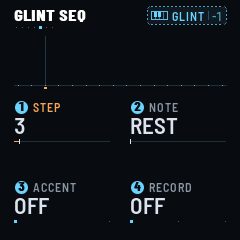
K2 and K3 on GLINT SEQ change the step on STEP: its NOTE (REST all the way down, TIE all the way up: the last note held on through it), shown as it sounds, OCTAVE and all, and its ACCENT. GATE is how long each note sounds, from a twentieth of its step to all of it. A TIE holds a note on, legato; with SUSTAIN up, GLINT’s leads then sing through. CLEAR: turn it once (AGAIN), then once more: every step a rest.
On GLINT SEQ III, NEW TAKE and UNDO TAKE turn twice the same way. NEW TAKE: every step a rest, RECORD on LIVE, the sequence started if it was stopped: play it in again from nothing. UNDO TAKE: the sequence as it was before the last take (REC, NEW TAKE) or CLEAR; again, back to the one after.
The screen draws the sequence as a constellation across the strip, 16 steps wide while SEQ LENGTH is 16 or less, else 32: a star a step, as high as its note, larger with an accent; a line for a tie, a dot for a rest; past SEQ LENGTH, grey. The step playing is white, with a line of light through it; the step on STEP has an amber mark under it. With RECORD on LIVE, an amber light shines in the corner. While RECORD is on, the strip is ruled, faintly: a line each whole tone, so a note sits on a line or between two (fewer lines when the notes span more, the Cs a touch brighter), and a column each step. The column being recorded into is lit in ice: on STEP, the one the next key writes; on LIVE, the one playing. RECORD off, the rules go. The keys light the note playing, the scale’s notes faintly.
Each scene keeps its own sequence, and the settings keep the last one saved.
The delayLink to this section
The delay is GLINT’s alone, on GLINT DELAY, its fourth page. TIME follows MIDI clock, or TEMPO: from 1/32 to 1/2 with triplets and dotted times, mono, then the same twelve again in ping-pong, marked PP (1/8D PP by default). Its echoes go into the cloud too; SPACE, beside them on K4, is how much of GLINT goes there.