
Guide 09 / 16
BASS
One deep note at a time, held like a drone, under everything, or its own line of sixteen steps: eight models, a soft clip, a resonant low-pass.
Again: ADSR, BASS SEQ · REC: record
Playing BASSLink to this section
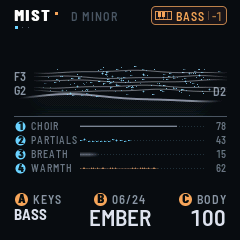
Press SEQ (come from another section, its pages put the keys on BASS), or turn SELECT (KEYS) to BASS: the keys play BASS (the badge turns orange). One note at a time, deep and steady: one of eight MODELs, DRIVE into a soft clip, through a resonant low-pass. None of it goes into the reverb.
| Gesture | What happens |
|---|---|
| Tap a key | The bass holds that note: the key’s note in the scale, OCTAVE octaves down. It rises over ATTACK, then settles over DECAY to SUSTAIN |
| Tap another key | The bass glides to its note (GLIDE), without a gap: it rises to the top again from where it is (with SUSTAIN at 100 %, it simply goes on) |
| Tap the bass’s key | It lets go, over RELEASE |
| Hold its key and press | Louder, and its filter opens. Let go: it stays |
With GLOBAL › KEY MODE on HOLD, the bass sounds while its key is down. Holding PLAY lets it go with everything else. It stays when you turn the keys back to drones or GLINT: SEQ, or SELECT on BASS again, comes back to it.
The modelsLink to this section
- SINE
- pure
- TRIANGLE
- soft, a little hollow
- SQUARE
- hollow, woody
- SAW
- bright, buzzing
- REESE
- two saws ten cents apart, beating slowly
- SUB
- the sine and its octave below
- ORGAN
- three drawbars: the note, its octave and its twelfth
- FM
- a sine modulating itself: round, growling
Turning MODEL while the bass sounds crosses over in a few milliseconds, without a click.
Its pagesLink to this section
Tap SEQ, then SEQ again for the next: BASS, BASS II, BASS ADSR, then its sequencer’s two, BASS SEQ and BASS SEQ II.
| Page | K1 | K2 | K3 | K4 |
|---|---|---|---|---|
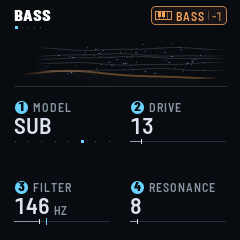
| BASS | MODEL SINE, TRIANGLE, SQUARE, SAW, REESE, SUB, ORGAN, FM | DRIVE clean to soft-clipped | FILTER 40 Hz to 5 kHz | RESONANCE Q 0.5 to 6 |
| BASS II | LEVEL | OCTAVE −2, −1, 0 under the keys | GLIDE OFF to 2 s | PULSE OFF, 1/8 BEAT to 4 BEATS |
| BASS ADSR | ATTACK 5 ms to 5 s | DECAY 10 ms to 10 s | SUSTAIN 0 to 100 % | RELEASE 30 ms to 15 s |
| BASS SEQ | STEP 1 to 16 | NOTE CUT, a note, HOLD | STEP LENGTH 1/16 to 4 BARS | RECORD OFF, STEP, LIVE |
| BASS SEQ II | STEPS 1 to 16 | SEQUENCE OFF, ON | CLEAR turn twice | TRANSPOSE −14 to +14 steps of the scale |
The envelope and PULSELink to this section
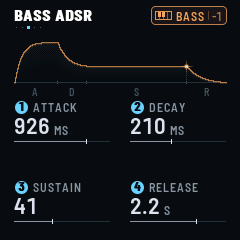
BASS ADSR is the envelope, in its usual order: ATTACK, how long a note takes to rise to the top; DECAY, how long it then takes, while the note is held, to come down to SUSTAIN’s level; SUSTAIN, the level it holds while the note is held; RELEASE, how long it fades once let go. Each note played rises from where the bass is, over ATTACK, then decays again. At SUSTAIN 100 %, as it starts, DECAY does nothing: there is nothing to come down to, and the bass holds, as it always has. Lower SUSTAIN to hear DECAY; at 0 % a held note fades to silence over DECAY.
On BASS ADSR the river strip draws the envelope: ATTACK up to the top, DECAY down to SUSTAIN’s level, SUSTAIN’s plateau, RELEASE down to nothing, each part as wide as its knob is turned (the plateau takes what is left), its time across it, A D S R under it. The part whose knob you turn is lit. The bass’s note is a little glint of lamp light riding the curve: it waits at the end of the plateau while the note is held, then goes down RELEASE once let go.
PULSE (BASS II, K4) makes the held note pulse on the grid (MIDI clock, else TEMPO, from the beat): OFF, 1/8 BEAT, 1/4 BEAT, 1/2 BEAT, 1 BEAT, 2 BEATS or 4 BEATS. On each, the note is let go for a moment and played again: it fades over RELEASE through a short gap, then rises over ATTACK and settles over DECAY to SUSTAIN once more, the same note at the same velocity, without gliding; pressing into it carries on. The gap is a quarter of the division, 8 ms at least and 60 ms at most: at 120 BPM, 16 ms on 1/8 BEAT, 31 ms on 1/4 BEAT, 60 ms from 1/2 BEAT on. A short RELEASE and a low SUSTAIN make a hard, gated pulse; a long RELEASE, a gentle swell on each beat. It pulses whatever plays the bass: a key, a latched note, MIDI or the sequencer, inside its NOTEs only: never in a CUT, and a step that begins with a NOTE is that division’s attack itself.
The sequencerLink to this section
Turn SEQUENCE (BASS SEQ II, K2) ON, or tap REC with the keys on BASS. Sixteen steps play the bass one after the other, on GLINT’s grid: MIDI clock when one comes in, else TEMPO. Each step is a NOTE, a CUT or a HOLD, and has its own STEP LENGTH: 1/16, 1/8, 1/4 (a beat), 1/4D, 1/2, 1/2D, 1 BAR, 1.5 BARS, 2 BARS, 3 BARS or 4 BARS. As a step begins, a NOTE plays its note (gliding from the last, as GLIDE says), a CUT stops the bass (it fades over RELEASE), a HOLD changes nothing: a note lasts until the next NOTE or CUT. STEPS (K1) is how many of the sixteen play; a turn lasts as long as their lengths together.
The steps keep their notes as the keys play them, without OCTAVE: turning OCTAVE moves the whole sequence. Two NOTEs of the same pitch in a row are one note held on (with SUSTAIN under 100 %, the second rises to the top again): a CUT between them makes two.
PLAY is both sequencers’ transport: it stops GLINT’s sequence and the bass’s together, and starts them again together from their first steps, at once, the beat beginning there (following a MIDI clock: on GLINT’s next step, else the next sixteenth, the clock’s beats kept). MIDI Start starts it from its first step. Holding PLAY (RELEASE ALL) stops it with everything else; holding it again (RESTORE) starts it again from its first step. Both start the beat there too.
| RECORD | What a BASS key does |
|---|---|
| OFF | Transposes the sequence, from its first NOTE to the key’s, along the scale. TRANSPOSE (BASS SEQ II, K4) shows how far, and turns it back. The key sounds nothing itself |
| STEP | Writes its note on STEP, with the STEP LENGTH set last, then STEP moves on, round STEPS. The note sounds while the key is down. BASS’s MIDI notes do the same |
| LIVE | Play while it runs: a take. The note sounds as you play it and goes in as you played it, its start and its length to the nearest sixteenth, over the time it covers and nothing else; the steps are written again around it, as few as the STEP LENGTHs make it (a 5/16 note, a NOTE of 1/4 and a HOLD of 1/16) |
K2 and K3 on BASS SEQ change the step on STEP: its NOTE (as the bass plays it; CUT all the way down, HOLD all the way up) and its STEP LENGTH. CLEAR, turned twice, makes every step a CUT, a sixteenth long (recording LIVE, the next note starts a new take, as on an empty sequence).
On STEP, the length carries on: each key writes its step with the STEP LENGTH you set last, so a run of notes all take the same length until you turn it again. Meanwhile STEP LENGTH (K3) shows the length the next key will write, starting as the length of the step STEP was on: turned, it sets that step at once, and the steps after it. NOTE (K2) changes the step’s note alone. With RECORD off, K3 is the step on STEP’s own length again.
On LIVE, a key pressed while another is down ends that one where it begins (legato); let go, the one still down takes over. While a key is down the sequence’s own steps under it are silent, the bass playing one note at a time: what you hear is what the loop will hold.
- Over a sequence, the take records within its loop, round and round, and the loop keeps its length (STEPS follows the steps it takes). A note replaces the time it covers and nothing else; a note it cuts short does not sound on after it from its middle, a CUT up to that note’s next NOTE or CUT.
- On an empty sequence (no NOTE in the steps it plays), the take makes the loop. It starts at the bar of the first note you play (bars counted from the sequence’s first step, as the metronome counts them; a note just before a bar line belongs to the next bar), a CUT before the note in its bar, and grows a bar at a time, the metronome’s higher tick on each bar line. REC again (or RECORD off, or PLAY) ends it: the loop runs to the bar line nearest the moment you stopped, never before the start of the last note, with a CUT to its end, and STEPS is set. A note still down then holds on to that line.
- Sixteen steps at most. A note that needs more goes in legato if that makes it fit: the silence after it held by it, else the one before it held by the note before, else both (BASS SEQ FULL · JOINED LEGATO). If it still does not fit, it is not recorded (BASS SEQ FULL · NOT RECORDED): the notes already in stay, later ones still go in where they fit. A take on an empty sequence with no room for another bar ends its loop there (BASS SEQ FULL · LOOP CLOSED) and goes on round it.
REC, with the keys on BASS, goes straight in: SEQUENCE on, RECORD on LIVE, BASS SEQ on screen, the sequence started; REC again, on LIVE or STEP, turns RECORD off. While RECORD is on, STEP or LIVE, the keys play BASS; RECORD off gives them back. On LIVE the metronome counts the bass sequence’s own beats from its first step, the higher tick as it comes round to it (its beats again from the top each time round, if it is not a whole number of beats long; a take on an empty sequence, on each bar line too), and REC flashes on them; on STEP the metronome is silent and REC stays lit.
The screen draws the sequence as a line of time: each step as wide as it is long; a NOTE a line at its note’s height, on through its HOLDs, the water under it down to the bed; a CUT, nothing. The note playing is bright, the playhead a line of lamp light going along. While RECORD is on, the strip is ruled, faintly: a line each whole tone (fewer when the notes span more), a column each step, as wide as it is long; the column being recorded into is lit in lamp: on STEP, the one the next key writes; on LIVE, the one playing. On LIVE, the note you hold is drawn bright as you hold it, from where you pressed it to the playhead; let go, it is written in.
Each scene keeps its own bass sequence, with its SEQUENCE, STEPS and TRANSPOSE, as GLINT’s its SEQ setting, SEQ LENGTH and TRANSPOSE: a scene loaded plays its own, or none. While SEQUENCE is on, notes on BASS’s MIDI channel go into the sequencer as the keys do.
On the small speakerLink to this section
A pure sine this low barely reaches the FM-1’s small speaker: DRIVE, or a richer MODEL, gives it the harmonics that let you hear it there. In headphones or a mixer, SINE with DRIVE at 0 is a clean sub.